Franklin Marshall College Liberal Arts College in Lancaster Pennsylvania
 | |
| Motto | Lux et Lex (Latin) |
|---|---|
| Motto in English language | Light and Law |
| Type | Private liberal arts higher |
| Established | 1787 (1787) |
| Academic affiliations | Space-grant |
| Endowment | $350.4 million (2020)[1] |
| President | Barbara Yard. Altmann[2] |
| Academic staff | 207 |
| Undergraduates | 2,283[3] |
| Location | Lancaster, Pennsylvania United States |
| Campus | Urban 220 acres (89 ha)[3] |
| Nickname | Diplomats |
| Website | www |
 | |
Franklin & Marshall College (F&M) is a individual liberal arts college in Lancaster, Pennsylvania. Information technology employs 175 full-time kinesthesia members and has a student body of approximately ii,400 total-time students.
| Franklin and Marshall College Campus Celebrated District | |
| U.S. National Register of Historic Places | |
| U.S. Historic district | |
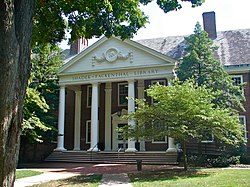 Shadek-Fackenthal Library (1934-35), the youngest building in the district | |
| Show map of Pennsylvania Testify map of the U.s.a. | |
| Location | College Avenue, Lancaster, Pennsylvania |
|---|---|
| Expanse | 23 acres (9.3 ha) |
| Architect | Dixon, Balbirnie & Dixon; et al. |
| Architectural manner | Gothic Revival, Tudor Revival |
| NRHP referenceNo. | 03001190[4] |
| Added to NRHP | Nov 21, 2003 |

History [edit]
Franklin Higher (18th century) [edit]
Franklin Higher was chartered on June 6, 1787, in Lancaster, Pennsylvania, on the site of a former brewery.[5] It was named for Benjamin Franklin, who donated £200 to the new institution.[vi] Founded by four prominent ministers from the German Reformed Church and the Lutheran Church, in conjunction with numerous Philadelphians, the schoolhouse was established equally a German college whose goal was "to preserve our present republican organization of government," and "to promote those improvements in the arts and sciences which alone render nations respectable, swell and happy." Its showtime trustees included 5 signers of the Declaration of Independence, ii members of the Ramble Convention and seven officers of the Revolutionary War.[7]
The school'south offset classes were taught on July 16, 1787, with instruction taking identify in both English and German, making it the get-go bilingual college in the United states of america.[8] [ citation needed ]
The first class consisted of 78 men and 36 women; Franklin was the first higher in the United States to take female students. "Withal, the coed policy was soon abandoned. Coeducation was not revived at the Higher for another 182 years."[9]
In July 1789, Franklin Higher went into debt because its annual tuition of 4 pounds was not enough to cover operating costs. Enrollment dwindled to just a few students and eventually the college existed as zip more an almanac meeting of the lath of trustees. In an endeavor to help the ailing school, an university was established in 1807. For the next iii decades, Franklin Higher and Franklin Academy managed to limp along financially, with instructors supplementing their income with private tutoring.[8] [ commendation needed ]
Marshall Higher (19th century) [edit]
Having grown from a Reformed Church academy, Marshall College opened in 1836 in Mercersburg, Pennsylvania.[10] The schoolhouse was named for the 4th Chief Justice of the United States John Marshall, who had died the previous year. Information technology was founded with the belief that harmony between knowledge and will was necessary to create a well-rounded person.
During its first year, 18 students were taught by Frederick Augustus Rauch and his banana, Samuel A. Budd. Rauch, an acclaimed young scholar and theologian from Germany who authored the first American textbook in psychology, too served equally the college's president.[ citation needed ]
The schoolhouse's small faculty grew in both size and status with the addition of John Williamson Nevin and another German scholar, church building historian Philip Schaff. Nevin became the college's president upon Rauch's sudden death in 1841.[ commendation needed ]
Life at Marshall College was regimented. Students were required to nourish forenoon prayers—sometimes as early as 5 a.yard.—and were expected to study in their rooms for vi hours a day. In addition, they were forbidden to associate with people of questionable moral character.[ citation needed ]
Marshall College quickly gained national recognition and attracted students from a large geographical area, with some coming as far abroad as the West Indies. However, despite being initially well-funded, Marshall College began to experience fiscal difficulties of its own. By the late 1840s, financial back up and enthusiasm amongst the local community had well-nigh disappeared and the school was in danger of closing its doors permanently.[ citation needed ]
In 1835, the schoolhouse's Debating Order was renamed Diagnothian Literary Society at the suggestion of seminary student Samuel Reed Fisher. That June, Diagnothian was divided into ii friendly rivals to encourage debate. Diagnothian retained its original name, while the new society was named Goethean, in honor of German language philosopher and poet Johann Wolfgang von Goethe. The ii organizations sponsored orations and debated politics, philosophy and literature. They merged in 1955, simply became separate entities again in 1989. The Diagnothian Lodge is the oldest student organization on campus.[ commendation needed ]
Merger [edit]
On Dec six, 1849, Franklin College and Marshall Higher began to consider merging every bit a way to secure the future of both institutions. 3 years later, on June seven, 1853, the combined higher was formally dedicated at Lancaster's Fulton Hall. The merger created an all-male Reformed Church institution that combined the resources of both schools. James Buchanan, four years prior to becoming the 15th President of the United states of america, was named president of the first Franklin & Marshall board of trustees.
The college's first two presidents, Emanuel Vogel Gerhart, a Marshall College graduate, and Nevin struggled to continue the young school afloat with an inadequate endowment. The hope of creating a reputable liberal arts establishment fueled their efforts to push on. "No 2d- or third-rate school will do," said Nevin at the formal dedication of the united college. "We must either have no college at all or else accept i that may be in all respects worthy of the proper name."[ commendation needed ]
The citizens of Lancaster agreed to donate $25,000 towards the construction of a building for the merged higher. A site on the east end of the city was proposed well-nigh where the new Lancaster County Prison was constructed in 1851. Two parallel streets in the area were renamed, one for Franklin and one for Marshall.[8] However, Buchanan ultimately rejected the proposal, saying "I practise not recall the best location for a literary institution should be between a court house and a jail." Instead, Buchanan and the lath selected a site at the northwestern end of Lancaster. Known locally as "Gallows Hill," it was the former site of Lancaster's public executions and the highest point of footing in city. At the laying of the building'south cornerstone in 1853, Henry Harbaugh, a Marshall College graduate and pastor of the Reformed Church of Lancaster noted that the city's everyman point was the prison. Harbaugh stated: "Thank God! The College stands higher than the jail. Educational activity should be lifted up and let crime sink to the lowest depths!" The distinctive, tall-towered construction, designed in the Gothic Revival mode, was defended on May 16, 1856, as "Recitation Hall." Recitation Hall came to exist known equally "Old Principal" and the footing as "College Hill".[11]
Franklin and Marshall College took as its motto the Latin phrase Lux et Lex, which translates in English to "Light and Law". This reversed the Marshall College motto Lex et Lux. While legend has it that the switch was the result of an fault past an engraver, it has since been suggested that the words deliberately reflect its namesakes Benjamin Franklin ("calorie-free") and John Marshall ("law").
The college seal depicts profiles of Franklin and Marshall looking to the left. It has been suggested that this represents the two leaders looking westward to the time to come expansion of the U.s.a.. Despite his nominal secondary priority, John Marshall is on the left of the seal and Benjamin Franklin is on the right. Merely Franklin's entire caput is shown, while Marshall's contour is cut off and far in the background. Speculation has suggested that this demonstrates an unspoken tendency to favor Franklin'southward legacy over Marshall's. This preference became explicit when the school celebrated Benjamin Franklin's 300th altogether but ignored John Marshall'south 250th birthday during sequent semesters of the 2005–2006 academic twelvemonth. The school recognized Marshall's milestone birthday only after a petition was signed by a significant portion of students and faculty.[ citation needed ]
Old Main, Goethean Hall, and Diagnothian Hall were added to the National Register of Historic Places in 1975.[four]
Tardily 19th century [edit]
In 1872, the Franklin and Marshall University, an all-male person prep school, opened on campus. When it closed in 1943, it was the last prep schoolhouse in America to be directly affiliated with a private college or university. The academy'south first building, East Hall, was constructed in 1872. A 2d and larger edifice, Hartman Hall, replaced it in 1907. Both buildings were used past the college later on the university folded. Hartman Hall was demolished in 1975 followed by E Hall in 1978.
College Days, the outset student paper, began publication in 1873. Later educatee newspapers included The College Student (1881–1914), The F&M Weekly (1891–1915), The Student Weekly (1915–1964), The Blue and The White (1990–1992), and The Higher Reporter (1964–present).
Oriflamme, the Franklin and Marshall Higher yearbook, was established in 1883.
In 1887, the centennial celebration of Franklin College was held. By then, over 100 students were enrolled at F&One thousand.
1899 saw the germination of the college's first theatre grouping, the Franklin & Marshall Dramatic Association. The side by side year, it was renamed the Green Room Club. The lodge performed plays at Lancaster's Fulton Opera House. Because the college admitted only men, the female roles were played by local actresses. In 1937, the Green Room Theatre opened on campus. F&M alumni who have performed on the Green Room stage include Oscar-winning film director Franklin J. Schaffner and actors Roy Scheider and Care for Williams.
20th century [edit]

Old Principal, Franklin & Marshall College, c. 1910
The college grew quickly after World War I. Enrollment rose from around 300 students in 1920, to over 750 by 1930. In 1924, the architectural house of Klauder and Twenty-four hour period presented a master campus plan in the Colonial Revival mode. Dietz-Santee dormitory, Meyran-Franklin dormitory, the Mayser Physical Education Center, and Hensel Hall were all completed within three years. Two additional dormitories were planned, just never constructed.
The sesquicentennial celebration of Franklin College was held in October 1937. Pupil enrollment by then was 800. A commemorative plaque celebrating the sesquicentennial and the signing of the United states Constitution was presented to the college by the Lancaster County Historical Social club.
In 1939, the school began an aviation plan in the new Keiper Liberal Arts Edifice. The Aeronautical Laboratory eventually became a authorities-sponsored flight school with 40 faculty members. Two airplanes were disassembled, moved into the edifice and reassembled on the 3rd flooring every bit flying simulators.
During World War Ii, Franklin and Marshall College was one of 131 colleges and universities that adopted the V-12 Navy Higher Training Program offering students a path to a Navy commission.[12]
By 1945, with near young men in the armed services, the college population dwindled to just under 500 students and 28 faculty members. The stop of the war brought an influx of students pursuing degrees under the G.I. Bill. By 1946, enrollment had swelled to over 1,200 students (including 4 women in the pre-med program), causing a sudden critical shortage of faculty.
The 1950s and 1960s brought more college expansion and structure, including North Museum (1953); Marshall-Buchanan Residence Hall (1956), Appel Infirmary (1959), Schnader Residence Hall (1959), Mayser Physical Didactics Middle (1962), Benjamin Franklin Residence Halls (1964), Pfeiffer Scientific discipline Complex (now Hackman Physical Science Laboratory) (1967), Grundy Observatory (1967), Whitely Psychology Laboratory (1968), and Thomas Residence Hall (1968).
Like other academic institutions in the 1960s, Franklin and Marshall endured student protests during the Civil Rights Movement and the Vietnam State of war. In April 1961, students rioted in front of the President'southward house and Hensel Hall, called-for effigies and college property in protest of assistants policies.[ citation needed ]
Martin Luther Rex Jr. visited the campus on December 12, 1963, 3 weeks afterward the assassination of John F. Kennedy, and spoke on civil rights to an overflow crowd of more than 4,000 in Mayser Center, the school's gymnasium.[xiii]
In 1965 Robert Mezey, a 30-twelvemonth-old visiting English instructor and poet, spoke on campus against the Vietnam State of war, and traveled to Washington, DC to march against the conflict. When he was accused of urging students to burn their draft cards, he was suspended with pay for a calendar month while the higher investigated. The incident generated controversy in the local printing, with some residents ordering him to "get the hell out of Lancaster" and "go to Russia." Though Mezey was reinstated, he left the college the following spring. This became known equally the "Mezey Thing."[14]
In the spring of 1969, blackness students protested the concluding examination of the history course "The Blackness Experience in America." Demanding an amends from the faculty for exploitation and an "A" in the course, the students argued that no white human being can test them on their "black." The twenty-four hours earlier the examination, the professors agreed to the apology, but insisted that the students take the concluding exam. On May 22, the solar day of the test, 40 black students—many of whom were not enrolled in the grade—blocked the entrance to the exam room in Erstwhile Main. The professors attempted to paw out the exam, but the protesters confiscated them. Retreating to Goethean Hall next door, the professors and staff met to evaluate the situation. The protesters followed them to the edifice, blocked all doors and exits and held them earnest, declaring that they would not release the faculty members until they received an apology and immunity from punishment. The standoff lasted until midnight, when the professors agreed to allow the students to grade themselves. The students relented and released the hostages. The higher's Professional Standards Committee later overturned the determination, declaring that the professors must form their students.[ commendation needed ]
In 1969, Franklin and Marshall Higher ended its formal amalgamation with the United Church building of Christ, condign a secular school.
Franklin College had enrolled female students during its first few years in the eighteenth century, to its university for teenagers. Franklin and Marshall College was an all-male institution. Women were permitted to attend summertime schoolhouse classes at F&M start in 1942. Continuing a tendency at gender exclusive schools across the state, the Lath of Trustees announced on January 17, 1969, that it had voted to admit women to F&M, a decision that was supported by male students. In the fall of 1969, 82 freshman women and 34 female person transfer students were enrolled in F&Chiliad's beginning coeducational class.
In 1970, F&M students protested the administration's failure to rehire popular sociology instructor Anthony Lazroe and history instructor Henry Mayer. The protestation, known as the "Lazroe-Mayer incident," culminated in an East Hall sit-in on Apr 30, where students took over the building for several hours.
On September 17, 1970, the Herman Art Heart (named afterward Jacob Leon Herman, Grade of 1916) was defended as part of Convocation, during which painter Jim Dine and sculptor Chaim Gross were awarded honorary degrees. The building was designed by Fisher, Nes and Campbell of Baltimore, Doc, for the studio fine art plan, but only half of the original blueprint was constructed due to lack of funds.
In 1976, the Steinman College Centre was constructed. The building—designed by Minoru Yamasaki, architect of New York'south World Trade Heart—originally housed the campus bookstore. Today it houses the College Reporter, the Oriflamme Yearbook, the College Entertainment Committee, the Phillips Museum of Art, Pandini's (a restaurant), the campus radio station WFNM, and a mail service part.
On April 29, 1976, the Light-green Room Theatre staged the world premiere of the John Updike play Buchanan Dying, about former President James Buchanan, a Lancaster resident and former president of the board of trustees. The product was directed by Edward Due south. Brubaker and starred Peter Vogt, an F&M alumnus. After the premiere, a reception was held at Wheatland, Buchanan's Lancaster residence.
On March 28, 1979, the Three Mile Island nuclear reactor in nearby Harrisburg, Pennsylvania, experienced a partial meltdown, forcing the college to close briefly.
The college prospered during the 1980s. Construction projects initiated during the decade included Hartman Green (1982), French Business firm (1984), Murray Arts House (1984), Ice Rink (1984), Spaulding Plaza (1985), and the Other Room Theatre (1985). Major renovations and expansions included Fackenthal Library (1983, renamed Shadek-Fackenthal Library, currently over 510,000 volumes), Stahr Hall (1985, renamed Stager Hall, 1988), the Black Cultural Center (1986), and Weis Residence Hall (1989).
On June 6, 1987, Franklin and Marshall College celebrated its bicentennial.
The 1990s brought a major expansion to the north side of campus with the construction of College Foursquare in 1991. The multi-use complex houses a bookstore, laundromat, video store, restaurants and a food court. Other buildings from the decade include International Firm (1990), Martin Library of the Sciences (1990, currently over 61,000 volumes), and the Alumni Sports and Fitness Center (1995).
21st century [edit]
At the get-go of the 21st century, the college connected to grow with the add-on of the Barshinger Center for Musical Arts in Hensel Hall (2000), President's Business firm (built 1933, purchased past the college in 2002), Roschel Performing Arts Eye (2003), Writer'southward Firm (2004), College Row Apartments (2007) which included apartment style living for upper-classmen with retail space on basis floors, the renovated Klehr Center for Jewish life (2008), and the Ann & Richard Barshinger Life Sciences & Philosophy Building (2007).
In 2003, the National Park Service established the Franklin and Marshall Higher Campus Historic Commune, listing 14 buildings (including Old Main, Goethean Hall, and Diagnothian Hall, previously listed in 1975) and iii architectural features.[xv]
On January nineteen, 2006, the college historic the tricentennial of Benjamin Franklin'due south birth. Franklin scholar Walter Isaacson gave a lecture, and a full-folio ad praising Franklin and promoting the college was purchased in The New York Times.
On March 10, 2010, it was announced that so electric current president John Fry would be leaving the higher to go the president of Drexel Academy on August ane, 2010. The higher immediately began a search for a new president for the autumn semester.[16] Alumnus John Burness took a i-year leave from his job at Knuckles University as senior vice president for public affairs and regime relations to head the college as acting president.[17]
On Nov sixteen, 2010, Daniel R. Porterfield was announced as the new president, effective March i, 2011. Porterfield came to F&M from Georgetown University in Washington, D.C., where he served as a senior vice president. He became the 15th president in the higher's history.[18]
Since 2011 hundreds of talented, underserved high schoolhouse students from across the land have taken part in F&One thousand College Prep, a summer immersion plan that offers an introduction to higher life. Each of these participants have gone on to higher, and more than 90% have gone on to enroll at four-twelvemonth colleges, including Harvard, Brown, Stanford, Georgetown, and Bucknell universities, the Academy of Texas-Austin, Pomona College, Trinity Higher, Spelman Higher, and Franklin & Marshall.[19] The Office of Student and Post-Graduate Development offering life skills workshops, job-search boot camps for seniors and recent grads, on-campus recruiting and alumni programming, opened in 2012 and enjoys wide back up from students and alumni.[20] The Andrew W. Mellon Foundation awarded F&Grand a $700,000 grant for its Kinesthesia Center, which was launched in 2013 to improve back up for kinesthesia in their roles as researchers and educators.[21]
On May 1, 2014, Franklin & Marshall College was named as one of 55 colleges under review or investigation by the U.S. Department of Education'southward Office for Civil Rights, for their policies or practices for handling sexual attack reports.[22] Prior to the public annunciation, President Porterfield sent an email to address the impending OCR "fact-finding investigation."[23]
Presidents [edit]
Franklin College:
- Gotthilf Heinrich Ernst Muhlenberg (1787–1815)
- Operated as an academy by Board of Trustees (1816–1853)
Marshall College:
- Frederick Augustus Rauch (1836–1841)
- The Rev. John Williamson Nevin (1841–1853)
Franklin and Marshall College:
- The Rev. Emanuel Vogel Gerhart '38 (1854–1866)
- John Williamson Nevin (1866–1876)
- The Rev. Thomas Gilmore Apple 'fifty (1877–1889)
- The Rev. John Summers Stahr '67 (1889–1909)
- Henry Harbaugh Apple tree '89 (1910–1935)
- John Ahlum Schaeffer '04 (1935–1941)
- H. M. J. Klein '93 (1941) (acting president)
- Theodore August Distler (1941–1954)
- William Webster Hall (1955–1957)
- Frederick deWolf Bolman, Jr. (1957–1962)
- Anthony R. Appel '35 (1962) (resigned afterwards 1 calendar week)
- G. Wayne Glick (1962) (acting president)
- Keith Spalding (1963–1983)
- James Lawrence Powell (1983–1988)
- A. Richard Kneedler '65 (1988–2002)
- John Anderson Fry (2002–2010)
- John Burness '67 (2010–2011) (interim president)
- Daniel R. Porterfield (2011–2018)
- Barbara K. Altmann (2018– )
Rankings [edit]
| Academic rankings | |
|---|---|
| Liberal arts colleges | |
| U.S. News & Globe Report [24] | 43 |
| Washington Monthly [25] | 25 |
| National | |
| Forbes [26] | 114 |
| THE/WSJ [27] | 91 |
Athletics [edit]
Sports accept been an active part of Franklin and Marshall since its inception. The college'south sports teams are called the Diplomats. Many of the teams compete in the Centennial Conference. Men'south intercollegiate competition is in fourteen sports: baseball game, basketball, cross state, football, golf, lacrosse, soccer, squash, pond, tennis, indoor track and field, outdoor track and field, wrestling, and rowing. Women's intercollegiate competition is in fourteen sports: basketball game, rowing, cross state, field hockey, golf, lacrosse, soccer, softball, squash, pond, tennis, indoor track and field, outdoor track and field, and volleyball. F&K competes in NCAA Division III for all varsity sports except wrestling, which is Division I, and men's and women's squash, which are nondivisional.[ commendation needed ]
The wrestling program competes for the Rupp Loving cup against local rival Millersville University.[ citation needed ]
In 1866, the student-run Blastoff Gild sponsored the higher'due south offset baseball game.[ citation needed ]
The Franklin & Marshall Diplomats football programme was starting time was organized in 1887 past Seminary student Miles O. Noll. Franklin and Marshall was defeated 9–0 by the York YMCA. Subsequently that twelvemonth, the program played a re-match and lost again, this time by score of 6–iv.[28] Frank Mount Pleasant became the caput football game coach in 1910.
Distler Business firm, the school's beginning gymnasium, was constructed in 1891 and contained a bowling alley, indoor running runway, and gymnastic equipment.[ citation needed ]
Sponaugle-Williamson Field was constructed in 1895 with the aid of $1,500 from Henry S. Williamson. Information technology was later renamed "Williamson Field." A physical grandstand was added in 1922 at a cost of $x,000.[ commendation needed ]
In 1900 the kickoff basketball game game was played. The opposing team was Millersville Normal School.[ citation needed ]
Professor Charles Due west. Mayser founded the F&Chiliad wrestling team in 1923, and early 1924 saw the college's first wrestling match as the Bluish & White defeated Western Maryland College 24–5. The Diplomat grapplers finished their maiden flavour with a iv–1 record. F&M wrestling competes in the EIWA and is the but Division Three schoolhouse to compete in Division I wrestling.
Mayser Concrete Educational activity Center, the college's 2nd gymnasium, was opened in 1927.[ commendation needed ]
In 1992, F&M became a charter member of the Centennial Briefing, an athletic briefing of xi mid-Atlantic institutions that compete in 22 sports in the NCAA's Sectionalization Three. The other founding members of the conference are Bryn Mawr Higher, Dickinson College, Gettysburg College, Haverford College, Johns Hopkins University, Muhlenberg Higher, Swarthmore College, Ursinus Higher, Western Maryland College, (renamed McDaniel College) and Washington College.[ citation needed ]
In 1995, the Alumni Sports and Fitness Center, the school's 3rd gymnasium, opened on the site of the college'southward former ice rink.[ citation needed ]
In 2007, the F&M women'due south lacrosse team won the NCAA Division III championship with an undefeated season record of 21–0. The women'due south lacrosse squad took back the NCAA Division III championship in 2009, for the second time in three years with a 21–one record. It marked the third consecutive year that the women's lacrosse team played in the title game.[ citation needed ]
The men'south basketball team has reached the NCAA Partitioning Three Terminal Four on five occasions (1979, 1991, 1996, 2000, 2009), appearing in the national championship game in 1991. The men's basketball team has been nationally ranked on a frequent basis since the belatedly 1970s, including No. ane in Division III at some point during 7 different seasons. Caput bus Glenn Robinson is the career leader in wins in Sectionalization III. Robinson has been listed as one of the top 100 college basketball coaches of all-time.[29]
Other successful able-bodied teams at F&One thousand include men's soccer, men'southward and women's swimming, baseball, and squash. They all traditionally compete for conference championships and have been ranked loftier nationally. In 2008, the men'south pond squad won the Centennial Briefing championships and the women's swimming team placed 2nd.[30] [31] At that championship, Thomas Anthony Grabiak Jr. of F&Thou set Centennial Conference championship encounter records in the 100 and 200 yd breaststroke events.[32] Men's squash consistently maintains a Tiptop-x Division I national ranking, having finished No. 8 in the past 2 seasons. In 1988, the men's lacrosse team finished the season 13-3 and played all the way until the USILA national semifinals.[ citation needed ]
Lodge sports [edit]
F&1000 also boasts several educatee-run clubs, most notably men'due south and women's rugby, both of which have become serious contenders for regional, and national championships each flavour and which compete in the Eastern Pennsylvania Rugby Union. Ultimate frisbee is too a pop club sport on campus, fielding both a men's and a women's team. In 2009, the college water polo team was revived and currently competes in the American Water Polo League and the Collegiate Water Polo League.[33]
Sponaugle–Williamson Field [edit]
 | |
 | |
| Location | Harrisburg Thruway Lancaster, PA 17604-3003 |
|---|---|
| Owner | Franklin & Marshall Higher |
| Operator | Franklin & Marshall College |
| Capacity | 4,000 |
| Surface | Kentucky bluegrass |
| Construction | |
| Broke ground | 1920 |
| Opened | 1920 |
| Tenants | |
| F&Grand Diplomats (NCAA) | |
Sponaugle–Williamson Field is a stadium for the outdoor able-bodied teams of the college. It was built in 1920 equally Williamson Field, named after S. Woodrow Sponaugle, who coached football game and basketball and was the able-bodied manager at F&Yard for 15 years. He shares the stadium's dedication with Henry South. Williamson, who was a trustee of the college from 1894 to 1917.[34]
Shadek Stadium [edit]
Shadek Stadium is used for football and lacrosse. Construction began in the fall of 2016 and ended in the fall of 2017. The stadium was named after the Shadek family, a family unit prominent at the school. The turf field in the stadium, Gilburg Field, is named after football role player and former F&M jitney Tom Gilburg. In the offset football game played in the stadium, the Diplomats defeated Centennial Conference rivals Dickinson College 56–0.[35]
Greek system [edit]
Chi Phi, founded on December 1, 1854, remains the only fraternity at F&M with a fraternity firm actually on the campus grounds. In 1929, through a special lease understanding with the college, the chapter built its business firm at 603 Race Avenue. The house was defended and opened in 1929, during the chapter'southward 75th anniversary celebration. During World War II, with school and fraternity omnipresence down, the house was converted to a temporary infirmary. In 1998, due to a series of disagreements with the college, the charter was terminated and the fraternity was evicted. On February 7, 2001, after iii years, Chi Phi renegotiated a new charter with F&M. They reoccupied the house the post-obit August.
In 1978, the schoolhouse'southward outset sorority, Sigma Sigma Sigma, was chartered. In 2005, the chapter became inactive.
In April 1988, the college's Board of Trustees voted to no longer officially recognize the school's fraternities and sororities. This was known as "derecognition." At the time, three of the school's fraternities had recently lost their national charters due to diverse offenses. In an try to repair the organization, the college administration proposed eight specific reforms to the Greek Quango, which were ultimately rejected by all of the organizations. The result was derecognition. This was highly unpopular with the pupil body, only it served to remove the college from any liability associated with hazing and underage alcohol corruption, issues that were in the national public eye at that time. The Greek system continued, admitting without financial or administrative support from the college. Subsequently several years, a small number of fraternities struggled with health lawmaking violations, fires, and one adventitious alcohol-related decease. Attributable to several factors, including dwindling financial support from fraternity and sorority alumni and legitimate concerns nigh student academics, wellness and safe, the college announced on May 19, 2004, that it would reinstate a new, revised Greek organization beginning on September i, 2004, afterwards a sixteen-year absenteeism.[36]
As part of the new agreement between the school's Greek organizations and the administration, fraternity and sorority houses are required to submit to weekly "life safety" inspections by schoolhouse officials, and inspections by the local fire department, police department, and role of public health conducted once per semester. An Inter-Fraternity Council consisting of representatives from all fraternities and brash past a member of the kinesthesia, too every bit a Greek Council consisting of members of all Greek organizations (male person and female person), similarly advised past a faculty member, were re-established to deal with issues facing the Greek community and advising the administration on Greek issues.
As recently every bit the autumn of 2008, relations between the assistants and the Greek system were strained. The administration placed a month-long moratorium on all Greek social events. During this period, the Interfraternity Council revised protocols governing parties, and the revisions were canonical by the administration resulting in the lifting of the moratorium, but the administration committed to more sternly enforcing the newly agreed-upon rules. At that place were also tensions between some members of the Greek organisation and Lancaster City, arising chiefly from incidents of criminal offence.
Concerns over the condition of Greek housing has led the administration and Greek organizations to examine different possibilities for improving the quality of housing options in order for such houses to receive continued support and approval from the college. In some cases, the result has been the temporary closure of Greek housing until the buildings can be brought up to school and town safety standards.
Greek life is a major part of F&M'due south customs. As of the spring of 2014, 43.7% of the F&M student body are members of the Greek Customs.[37]
List of fraternities [edit]
-
- ΧΦ Chi Phi, Zeta Chapter, autumn of 1854 (currently inactive) [38]
- ΦΚΣ Phi Kappa Sigma, Zeta Chapter, October 13, 1854[39]
- ΦΚΨ Phi Kappa Psi, Penn Eta Chapter, 1860
-
- ΔΤΔ Delta Tau Delta, Tau Prime Chapter, 1874–1895 (currently inactive) [38]
- ΦΣΚ Phi Sigma Kappa, Pi Affiliate, 1903–1983 (currently inactive) [40]
- ΔΣΦ Delta Sigma Phi, Upsilon Chapter, 1915–2015 (currently inactive)
- ΛΧΑ Lambda Chi Alpha, Alpha Theta Chapter, 1917–1980 (currently inactive)
- ΣΠ Sigma Pi, Nu Affiliate, 1918-2017 (currently inactive)
- ΦΚΤ Phi Kappa Tau, Xi Affiliate, 1921 (currently inactive)
- ΚΣ Kappa Sigma, Delta Rho Chapter, 1929-2021 (currently inactive)
- ΖΒΤ Zeta Beta Tau, Alpha Tau Chapter, 1931–1988, existed as Alpha Sigma Phi, Alpha Tau Affiliate, 1996–1998, ZBT 2016–present
-
- ΠΛΦ Pi Lambda Phi, Tau Affiliate, 1947, (currently inactive)
- ΦΣΠ Phi Sigma Pi, Zeta Beta Chapter, 2010
List of sororities [edit]
- ΑΦ Alpha Phi, Zeta Sigma Affiliate, 1982-19xx, 2008
- ΑΔΠ Blastoff Delta Pi, Theta Lambda Chapter, 2011
- ΑΞΔ Alpha Xi Delta, Iota Psi Chapter, 2014
- ΧΩ Chi Omega, Phi Lambda Affiliate, 1987
- ΚΔ Kappa Delta, Eta Lambda Chapter, 2008
-
- ΚΒΓ Kappa Beta Gamma, Nu Chapter, 2002–2008, currently inactive
- ΣΣΣ Sigma Sigma Sigma, Delta Nu Chapter, 1978–2005, currently inactive [38]
- ΔΣΘ Delta Sigma Theta, Lambda Gamma, 2017
- ΣΛΓ Sigma Lambda Gamma National Sorority Inc., 2019
Notable alumni [edit]
Notable alumni of Franklin & Marshall College include Edwin R. Keedy, Dean of the University of Pennsylvania Law School (class of 1899), Albert Clay, appointed as the offset William M. Laffan Professor of Assyriology and Babylonian Literature at Yale University in 1910,[ citation needed ] Nobel Prize-nominated medical researcher Theodore Eastward. Woodward (class of 1934),[ citation needed ] Academy Honour-winning pic manager Franklin Schaffner (1942),[ citation needed ] White Business firm Chief of Staff under Ronald Reagan Kenneth Duberstein (1965),[ commendation needed ] Baseball Commissioner Bowie Kuhn (1948),[ citation needed ] Academy Award-nominated thespian Roy Scheider (1955),[ citation needed ] House Majority Whip William H. Gray (1963), and Pulitzer Prize and Tony Award-winning playwright James Lapine (1971).[ citation needed ] United States Army Major Richard Winters, a notable commander of the 506th who parachuted into Normandy.
Wear visitor [edit]
In 1999, a company based in Verona, Italy began producing items of clothing in a vintage 1950s collegiate-style with the words "Franklin and Marshall" on them. F&Yard alumni began to report seeing F&M merchandise for auction in Europe, which puzzled the higher.[41]
In 2001, Tim McGraw posed for publicity photos wearing a "Franklin Marshall Wrestling" T-shirt,[42] one of which was included in the CD booklet for his album Set This Circus Down. When many asked Franklin & Marshall College virtually its nonexistent connectedness to the singer, the college investigated and discovered that the Franklin Marshall Clothing company was using its name without permission.[43] In 2003, the college licensed the proper name to the company so it could sell its products, many of which omit Franklin & Marshall's ampersand, in the United States.[41] [43]
The article of clothing company has stated in news reports that its designs are "inspired by the American Vintage College spirit, equally exemplified by Franklin & Marshall College."[44] Most of its products are made in Italy and are much more expensive than the Champion-produced licensed clothes sold past the college's bookstore. As of 2011[update] the company has stores in 6 cities: Athens, Dubai, Milan, Tokyo, and Paris, and also sells through high-end stores like Harrods in Uk. Although it no longer sells its products in the United States due to poor sales, in 2010 the visitor pledged to donate $130,000 to the college's scholarship fund.[45]
In 2013 Franklin & Marshall became a sponsor of Hellas Verona, a football (soccer) squad in the Italian Serie A.[46]
References [edit]
- ^ As of June xxx, 2020. U.South. and Canadian Institutions Listed by Fiscal Year 2020 Endowment Market Value and Change in Endowment Market Value from FY19 to FY20 (Written report). National Association of College and University Business organisation Officers and TIAA. February 19, 2021. Retrieved February twenty, 2021.
- ^ "Franklin & Marshall – F&M's New President". world wide web.fandm.edu.
- ^ a b "F&M Fast Facts". Franklin & Marshall Higher. Retrieved April 14, 2021.
- ^ a b "National Register Information System". National Register of Historic Places. National Park Service. July 9, 2010.
- ^ "Franklin and Marshall College Founding Documents Online". Archived from the original on June 10, 2010. Retrieved March 17, 2010.
- ^ "Letter of introduction : prototype". Library.fandm.edu. Archived from the original (JPG) on March 1, 2012. Retrieved February 23, 2016.
- ^ "1st paragraph of '"History'" section". Fandm.edu. Archived from the original on July 30, 2010. Retrieved 2011-03-12 .
- ^ a b c Dubbs, Joseph (1903). History of Franklin and Marshall College: Franklin College, 1787-1853; Marshall College, 1836-1853; Franklin and Marshall College, 1853-1903. Franklin and Marshall College Alumni Association.
- ^ Franklin & Marshall College. "History". Retrieved May 10, 2020.
- ^ "Papers of founding for Marshall College (See pages half dozen, as given by link, and vii)". Library.fandm.edu. Archived from the original on June 11, 2010. Retrieved Feb 23, 2016.
- ^ Harry Martin John Klein (1921). Lancaster'south Golden Century, 1821-1921: A Chronicle of Men and Women who Planned and Toiled to Build a City Strong and Beautiful. Hager and Brother. p. 71.
Give thanks God! The College stands college than the jail. Education should exist lifted upward and allow crime sink to the everyman depths!.
- ^ "Oral Histories Collection" (PDF). Lancaster, Pennsylvania: Franklin and Marshall College. 2011. Archived from the original (PDF) on June 9, 2010. Retrieved September 29, 2011.
- ^ Buckwalter, Jim (January 21, 2019). "Quotes from the Rev. Martin Luther Male monarch Jr.'s 1963 speech in Lancaster". LNP. Lancaster, Pennsylvania. Retrieved October 3, 2020.
- ^ "Poet who spoke at F&G; against Vietnam War recalls the time - Columns". July xviii, 2013. Archived from the original on July 18, 2013.
- ^ "Franklin & Marshall College Campus Historic Commune original nomination class" (PDF). Fandm.edu. Archived from the original (PDF) on February 26, 2014. Retrieved February 23, 2016.
- ^ [one] Archived March 15, 2010, at the Wayback Machine
- ^ Rupp, Lindsey (April thirteen, 2010). "John Burness to head Franklin & Marshall College". Duke Relate. Archived from the original on May 8, 2010. Retrieved November ii, 2018.
- ^ F&Yard Names New President – Pennsylvania News Story – WGAL The Susquehanna Valley Archived March viii, 2012, at the Wayback Auto. Wgal.com (2010-xi-16). Retrieved on 2010-12-10.
- ^ Forde, Dana (March 12, 2014). "Peers Providing Support to Vulnerable Start-generation Students - College Educational activity". Diverseeducation.com . Retrieved February 23, 2016.
- ^ "College Career Centers Stretch to Take On New Roles - The Chronicle of Higher Education". Relate.com. September 30, 2013. Retrieved February 23, 2016.
- ^ "Franklin & Marshall – New Faculty Middle Awarded Mellon Grant". Fandm.edu. March 28, 2014. Retrieved February 23, 2016.
- ^ "55 Colleges Face Sexual Assault Investigations". Huffingtonpost.com. July 1, 2014. Retrieved February 23, 2016.
- ^ "2013-14 Letters from the President". Archived from the original on Oct 18, 2014. Retrieved October 13, 2014.
- ^ "Best Colleges 2021: National Liberal Arts Colleges". U.Due south. News & Earth Study . Retrieved September 24, 2020.
- ^ "2021 Liberal Arts Rankings". Washington Monthly . Retrieved September 9, 2021.
- ^ "America's Top Colleges 2021". Forbes . Retrieved September 9, 2021.
- ^ "Wall Street Journal/Times College Education Higher Rankings 2021". The Wall Street Journal/Times Higher Education . Retrieved October 20, 2020.
- ^ DeLassus, David. "Coaching Records Game-past-Game (K.O. Noll)". College Football Data Warehouse. Retrieved Apr 18, 2011.
- ^ Brandon Croce (July 18, 2011). "100 Best Coaches in College Basketball History". Bleacher Report. Retrieved Feb 23, 2016.
- ^ "2009 Men'due south Swimming Championship". Archived from the original on Feb 26, 2009. Retrieved September 26, 2009.
- ^ "Women's Pond 2009". Archived from the original on October 7, 2010. Retrieved September 26, 2009.
- ^ "Centennial Conference Individual Men's Swimming Champions 1994–2008" (PDF) . Retrieved September 26, 2009. [ dead link ]
- ^ "2012 Mid-Atlantic Sectionalization Schedule: Collegiate Water Polo Clan". Collegiatewaterpolo.org. Archived from the original on October 19, 2014. Retrieved February 23, 2016.
- ^ "Refreshing to..." www.cstv.com.
- ^ "Franklin & Marshall – Shadek Stadium". www.fandm.edu.
- ^ — Jack Stripling (March eight, 2011). "Stripling, Jack. "Render of the Greeks." "Inside Higher Ed", Dec 22, 2009". Insidehighered.com. Retrieved March 12, 2011.
- ^ "F&M Fraternity & Sorority History". Archived from the original on August 10, 2014. Retrieved Baronial x, 2014.
- ^ a b c Anson, Jack L.; Marchenasi, Robert F., eds. (1991) [1879]. Baird's Transmission of American College Fraternities (20th ed.). Indianapolis, IN: Baird's Manual Foundation, Inc. pp. III-31. ISBN978-0963715906. . Baird'southward Transmission is also available online here: The Baird's Manual Online Annal homepage.
- ^ Pilgram, Robert J. (1930). Full general register of the members of Phi Kappa Sigma Fraternity, 1850–1930. Philadelphia, Phi Kappa Sigma Fraternity. p. 190. OCLC 10486816.
- ^ Rand, Frank Prentice; Ralph Watts; James Eastward. Sefton (1993), All The Phi Sigs - A History, Thousand Chapter of Phi Sigma Kappa
- ^ a b "Franklin & Marshall Signs Licensing Understanding with Italian Clothing Company" (Press release). Franklin & Marshall College. June 25, 2003. Archived from the original on Dec 2, 2008. Retrieved December 28, 2011.
{{cite press release}}: CS1 maint: bot: original URL status unknown (link) - ^ "COUNTRY Shell: Tim McGraw, Jeff Carson, Tracy Byrd ..." MTV. October ix, 2001. Retrieved February 23, 2016.
- ^ a b Roggie, Alyssa (Autumn 2001). "What'due south in a name?". Franklin & Marshall mag. Archived from the original on March 24, 2012. Retrieved December 28, 2011.
- ^ Luzer, Daniel (April 2, 2010). "Franklin & Marshall's Clothing Line". Washington Monthly. Archived from the original on April half dozen, 2010. Retrieved December 5, 2014.
- ^ Elbaum, Rachel. "Why do Europeans wear small U.South. higher's logo?". Today (NBC News). Archived from the original on Jan 7, 2012. Retrieved December 28, 2011.
- ^ "Franklin & Marshall Becomes Primary Sponsor of Hellas Verona". Isportconnect.com. Nov 29, 2013. Retrieved Feb 23, 2016.
Coordinates: 40°2′49″Northward 76°19′fourteen″W / 40.04694°N 76.32056°West / twoscore.04694; -76.32056
External links [edit]
- Official website
- Official athletics website
- Illinois Digital Paper Collections: F&Grand College Reporter (1964-1987)
lewallendoned1995.blogspot.com
Source: https://en.wikipedia.org/wiki/Franklin_&_Marshall_College
0 Response to "Franklin Marshall College Liberal Arts College in Lancaster Pennsylvania"
Post a Comment